
© Liz Carlson
Newfoundland Circumnavigation
July 8 to July 19, 2028
From $9,995 to $19,995 USD
per person based on double occupancy
Save 10% Applies to berth cost only.
Best Understood from the Sea
Circumnavigate the island to discover an Atlantic world shaped by centuries of movement and exchange. These waters carried people, knowledge, livelihoods, and traditions between shores, connections that remain visible in the communities encountered today. From Mi'kmaw culture and Newfoundland's outports to French life in Saint-Pierre and Miquelon, each reveals a different relationship with the sea. Along the way, dramatic geology, wildlife, and rich food traditions deepen the story.
Newfoundland Circumnavigation

Map

- Day 1: St. John’s, NL, Canada
- Day 2: Miquelon, France
- Day 3: Miawpukek (Conne River), NL, Canada
- Day 4: Francois
- Day 5: South Coast
- Day 6–7: Gros Morne National Park and Woody Point
- Day 8: Red Bay
- Day 9: L’Anse aux Meadows
- Day 10–11: Northeast Coast
- Day 12: St. John’s, NL, Canada
Itinerary
-

© Andre Gallant
Often celebrated as North America’s oldest city, St. John’s is a glorious jumble of colourful houses, winding streets, steep hills, and unexpected laneways gathered around a harbour that could belong nowhere else. Beneath Signal Hill, the Narrows form a dramatic gateway between the sheltered waterfront and the open Atlantic, giving the city one of the continent’s most unmistakable settings.
Its centuries of history are matched by an energy that feels entirely of the moment. An emerging culinary scene brings fresh imagination to Newfoundland ingredients and traditions, while Water Street offers an eclectic mix of independent shops, galleries, cafés, and local character. When evening arrives, music spills from pubs and performance spaces, carrying a lively tradition that remains central to the city’s identity. Historic, creative, colourful, and full of personality, St. John’s makes an irresistible gateway to Newfoundland.
-
© Tom Cochrane
A small French community with a character shaped equally by Europe and the North Atlantic. Acadian, Basque, Breton, and Norman roots run through its history, while generations of fishing and farming have created traditions distinctly adapted to island life. French remains the language of everyday conversation, and local shops, cafés, and artisans give the village a quietly contemporary spirit.
Beyond the village lies a surprisingly varied natural world of rocky headlands, ponds, dunes, and wind-shaped vegetation. Miquelon is connected to Langlade by La Dune, a remarkable twelve-kilometre ribbon of sand formed by the meeting of ocean currents and the site of numerous shipwrecks. Trails open onto sweeping Atlantic views, with opportunities to encounter coastal flora and birdlife along the way.
Explore at your own pace, perhaps browsing locally made goods or pausing at a café. With French flavours, deep maritime roots, and wild landscapes close at hand, Miquelon feels unlike anywhere else in North America.
-
© Tom Cochrane
At the mouth of the Conne River lies Miawpukek, whose Mi’kmaw name means “Middle River.” Long used as a seasonal gathering place, it became a permanent community around 1822 and today is the only recognized First Nation reserve on the island of Newfoundland. Its history is part of a much older pattern of movement throughout Mi’kma’ki, the traditional territory of the Mi’kmaq.
Miawpukek is also a story of cultural strength and contemporary renewal. Language, traditional knowledge, education, ceremony, and community life remain closely connected, while present-day conservation initiatives carry an enduring responsibility to the surrounding lands and waters forward in new ways.
Receive a formal welcome from community leaders and spend time in Miawpukek, where history is not confined to the past but continues through living culture, modern leadership, and a relationship with place sustained across generations.
-
© Tom Cochrane
Hidden deep within a steep fjord, the outport of Francois can be reached only by boat. Colourful homes cling to the hillside in a community where the sea remains the way in and out. Explore waterfalls and lookout trails, wander through the settlement, and spend time talking with the people who continue to make their lives here.
As evening falls, we usually gather with the community for a joyful kitchen party—music, dance, laughter, and good company flowing as naturally as the tide. Raise a glass and join in the moment.
-
© Tom Cochrane
Along Newfoundland’s southern edge, the roads fall away and the sea becomes the highway. Deep fjords, sheltered coves, and towering headlands define a coast shaped by water, weather, and isolation. Its outports and resettled communities hold an important place in Newfoundland’s cultural memory, recalling generations whose lives were connected to the island primarily by sea.
The coastal barrens and bogs are alive with low-growing wildflowers, while seabirds gather along the cliffs and offshore waters. Capelin may draw whales into the bays. Bald eagles patrol the headlands, seals surface in sheltered coves, and waterfalls descend after the spring thaw.
Remote, roadless, and known intimately by the sea, the South Coast remains one of Newfoundland’s wildest and most compelling landscapes.
-
© Tom Cochrane
In Gros Morne National Park, Earth’s story is written in stone. The bronze-coloured slopes of the Tablelands expose rocks from deep within the Earth’s mantle—part of the geological evidence that helped transform our understanding of plate tectonics. Join Parks Canada naturalists for guided walks through this extraordinary landscape and learn why Gros Morne is recognized as a UNESCO World Heritage Site.
After exploring the Tablelands, experience the warm spirit of Woody Point, where artists, writers, and musicians continue to draw inspiration from the surrounding mountains and sea.
-
© Tom Cochrane
In the 1500s, Red Bay was a major centre of Basque whaling, connecting this Labrador harbour with communities across the Atlantic. Today, it is a UNESCO World Heritage Site.
Visit the interpretation centre to see recovered artifacts, including tools and personal items from the San Juan, lost here in 1565. Then cross to Saddle Island to explore remnants of the whaling station and consider the people, ships, knowledge, and commerce that once moved through these waters as part of an early transatlantic industry.
-
© Tom Cochrane
At the northern tip of Newfoundland, within a landscape shaped by some 6,000 years of Indigenous presence, a cluster of low ridges revealed a remarkable chapter in Atlantic history.
L’Anse aux Meadows is the only authenticated Norse archaeological site in the Americas and the earliest known evidence of a European presence on the continent. Its discovery confirmed that Norse seafarers reached North America around the year 1000, a journey preserved for centuries in the Icelandic sagas.
The remains of timber-framed turf dwellings, workshops, and a forge reveal a base camp built in the tradition of settlements in Greenland and Iceland. Among the finds was a hand-forged nail, evidence of the earliest known iron production in North America. Even more intriguing are butternuts, which do not grow naturally in Newfoundland and suggest voyages farther south.
The Norse presence was brief, but its discovery transformed an ancient saga into historical fact and secured L’Anse aux Meadows a place of global significance.
-
© Andre Gallant
Sailing Newfoundland's northeast coast brings you into communities whose histories and ways of life have long been oriented toward the sea. Depending on conditions and opportunities, visit small fishing communities where boats gather in sheltered coves and the wharf remains a natural place for conversation.
Spend time ashore, meet local people, and notice the details of coastal life—fishing stages and sheds, working boats, music, stories, and the easy wit that so often accompanies them. Harbour by harbour, another side of Newfoundland comes into view.
-
© Jacquie Matechuk
Return through the Narrows and beneath Signal Hill, completing a full circle around Newfoundland. St. John’s may appear much as it did at the beginning, but its colourful houses now sit within a broader palette of landscapes, stories, and communities encountered around the island.
Along the way, the sea has been more than a backdrop. It connects distant shores, sustains communities, shapes traditions, and finds its way into Newfoundland’s music and song. From lively harbours to roadless coastlines, the island’s character is grounded in the strength, wit, creativity, and warmth of its people.
Twelve days and an entire island later, the circle closes where it began, with the Narrows ahead and a whole island’s worth of stories, songs, and good company astern. As they say in Newfoundland, long may your big jib draw.


Published itineraries reflect our intended route and experiences but cannot be guaranteed. Weather, sea and ice conditions, government regulations, operational considerations, wildlife, and other circumstances may require changes to the planned schedule. Visits to specific communities also depend on local conditions and the needs, availability, and requests of the communities themselves. When changes are necessary, we will seek the best available alternatives, including another community visit where circumstances allow.
Pricing and Cabins
Canadian residents may opt to use our in-house exchange rate (fixed quarterly) and pay for their voyage in Canadian dollars. Contact Adventure Canada or your travel advisor for more details.
-


- Window
- One lower berth
- Bathroom with a shower
- Hair dryer, bathrobe, towels, body wash, and hair care products
- Desk with a chair
- Air ventilation
- Heater under desk
- Electrical outlets: 220V/50Hz (European)
- Cupboard
- Wardrobe
- Approximately 86–114 square feet
![Upper Deck]()
-

- Window
- Two lower berths
- Bathroom with a shower
- Hair dryer, bathrobe, towels, body wash, and hair care products
- Desk with a chair
- Air ventilation
- Heater under desk
- Electrical outlets: 220V/50Hz (European)
- Cupboard
- Two wardrobes
- Approximately 145–156 square feet
![Upper Deck]()
-

- Window
- Two lower berths
- Bathroom with a shower
- Hair dryer, bathrobe, towels, body wash, and hair care products
- Desk with a chair
- Air ventilation
- Heater under desk
- Electrical outlets: 220V/50Hz (European)
- Cupboard
- Wardrobe
- Approximately 104–112 square feet
![Bridge Deck]()
-


- Window
- Two lower berths. Limited matrimonial bed availability upon request
- Bathroom with a shower
- Hair dryer, bathrobe, towels, body wash, and hair care products
- Desk with a chair
- Air ventilation
- Heater under desk
- Electrical outlets: 220V/50Hz (European)
- Cupboard
- Wardrobe
- Approximately 106–140 square feet
![Upper Deck]()
-


- Window
- Bunk bed twin
- Bathroom with a shower
- Hair dryer, bathrobe, towels, body wash, and hair care products
- Desk with a chair
- Air ventilation
- Heater under desk
- Electrical outlets: 220V/50Hz (European)
- Cupboard
- Wardrobe
- Approximately 86–122 square feet
![Upper Deck]()
-


- Window
- Two lower and one upper berth
- Bathroom with a shower
- Hair dryer, bathrobe, towels, body wash, and hair care products
- Desk with a chair
- Air ventilation
- Heater under desk
- Electrical outlets: 220V/50Hz (European)
- Cupboard
- Two wardrobes
- Approximately 159 square feet
![Upper Deck]()


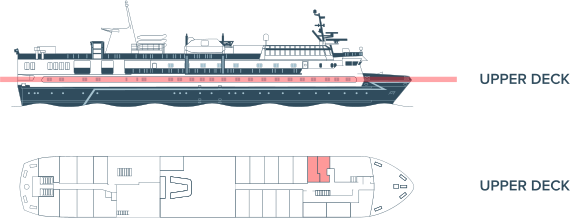

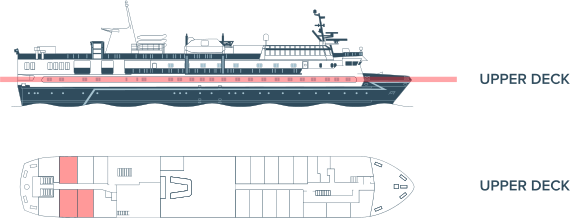

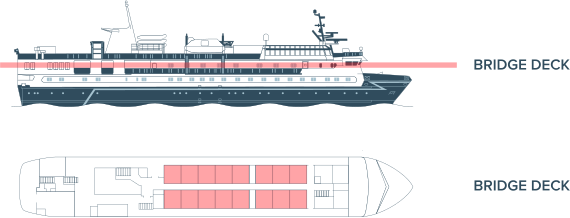


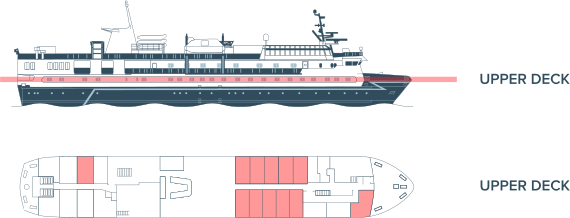


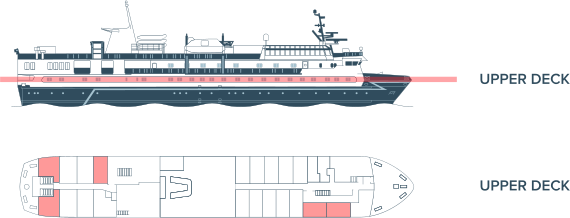


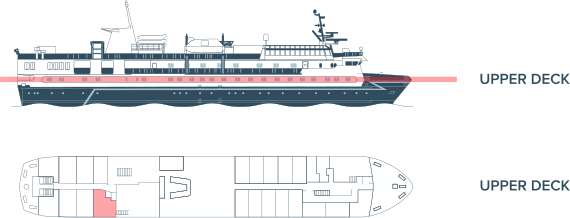
Ship

Ocean Nova
- Capacity for 75 guests
- Compact, cozy, and charming
- Designed for efficiency, functionality, and connection with nature
- Custom-built for ice-choked waters
Trip Extensions
Discover St. John's: Trip Extension 2028
Details
-
Newfoundland Circumnavigation
Tour Dates:
- July 08 - July 19, 2028
From $9,995 to $19,995 USD
per person based on double occupancy
Save 10% Applies to berth cost only.
-
Solo Supplement
Not available
-
Trip Starts
St. John’s, NL, Canada
Trip Ends
St. John’s, NL, Canada
Inclusions and Exclusions
Included:
- Passage aboard the Ocean Nova
- Applicable taxes and credit card fees
- Special access permits, entry, and park fees
- Complimentary expedition jacket
- Expert expedition team
- Guided activities
- Sightseeing and community visits
- All Zodiac excursions
- Port fees
- Pre-departure materials
- Educational program
- Interactive workshops
- Evening entertainment
- All shipboard meals
- Basic Wi-Fi access
Not Included:
- Commercial and charter flights
- Program enhancements/optional excursions
- Gratuities
- Personal expenses
- Mandatory medical evacuation insurance
- Additional expenses in the event of delays or itinerary changes
- Possible fuel surcharges and administrative fees
- Pre- and post-trip hotel accommodation
- Premium Wi-Fi access